Wednesday, September 21, 2022

Nancy's Story Teaching Resource

By Cynthia Wallace-Casey, PhD 
University of Ottawa
Honorary Research Associate
Fredericton Region Museum 

This Education Guide is intended to complement the short Heritage Fair video prepared by the Fredericton Region Museum, entitled “The Slavery Trial of Nancy, February 4-8, 1800”. The purpose of this material is to enhance your students’ learning experience, and to help create awareness that slavery really did happen here in New Brunswick. 

Nancy’s powerful story of human bondage is rarely shared in the classroom, due to the disturbing nature of the language of the time, and the cruel realizations that New Brunswick’s colonial past has been far less than ideal. Nancy’s story, however, gives us all reason to pause and reflect upon equality, liberty, justice, and freedom. 

Before viewing the video, please discuss the language and concepts students will encounter. Inside this guide you’ll find information to assist, as well as transcripts of the archival evidence presented in the video. You will also find guiding questions designed to lead your students in thinking about the Historical Significance of Nancy and her trial. Read more...


Remembering and Reconciliation: Teaching and Learning the Legacy of Residential Schools in Canada

By Cynthia Wallace-Casey, PhD 
University of Ottawa

History Education Research Journal, Volume 19, Number 1, 29 April 2022, pp. 1-18:

Abstract: In 2015, the Truth and Reconciliation Commission (TRC) of Canada released a Final Report containing 94 Calls to Action. Included were calls for reform in how history is taught in Canadian schools, so that students may learn to address such difficult topics in Canadian history as Indian Residential Schools, racism and cultural genocide. Operating somewhat in parallel to these reforms, social studies curricula across Canada have undergone substantial revisions. As a result, historical thinking is now firmly embedded within the curricula of most provinces and territories. Coupled with these developments are various academic debates regarding public pedagogy, difficult knowledge and student beliefs about Canada’s colonial past. Such debates require that researchers develop a better understanding of how knowledge related to Truth and Reconciliation is currently presented within Canadian classrooms, and how this may (or may not) relate to historical thinking. In this paper, I explore this debate as it relates to Indian Residential Schools. I then analyse a selection of classroom resources currently available in Canada for teaching about Truth and Reconciliation. In so doing, I consider how these relate to Peter Seixas’s six concepts of historical thinking (Seixas and Morton, 2013), as well as broader discussions within Canada about Indigenous world views, historical empathy and Reconciliation.  Read more...

Tuesday, January 11, 2022

Two-Volume Black History Special Edition Publication


Guest editor: Cynthia Wallace-Casey, PhD 
University of Ottawa 

It’s been an honour to participate in the development of this two-volume series of The Officers’ Quarters, devoted to Black history in New Brunswick. When I was first invited to embark on this journey in 2019, those of us at the Fredericton Region Museum were amazed at what little representation of Black history existed within the museum’s walls. Certainly, significant groundwork had already commenced in 2017, however, with the publication of a special Black History edition of The Officers’ Quarters. Thanks to guest editor Mary Louise McCarthy-Brandt, and the York-Sunbury Historical Society publication team, the stage was set to explore lesser-known aspects of Fredericton’s past. In that issue, readers were introduced to the historic slavery trial of Nancy; as well as descendants of Black Loyalist Solomon Kendall who lived on “The Hill” in Lower Queensbury. Readers were also reminded of the extraordinary significance of St Peter’s Church in Springhill, where there existed an “equality in Christ” rarely witnessed in Canadian history. This landmark publication left many of us wanting to learn more. 

Tuesday, February 2, 2021

Les Collections et les études sociales du N.-B.


Webinare Association Patrimoine Nouveau-Brunswick 
27 janvier, 2021 

Facilitatrice:  Dr. Cynthia Wallace-Casey, Université d'Ottawa

Ce webinaire aider à combler le fossé entre les éducateurs et les professionnels de musée au profit des jeunes. Les experts du musée apprendront à travailler avec les éducateurs en fonction des programmes actuels pour exciter les jeunes d’aujourd’hui à propos de L’histoire du N.-B. Afin qu’ils comprennent et/ou se connectent à leur passé et à leur communauté. Retrouvez l’enregistrement ici….

Museum Collections and NB Social Studies: Bridging the Two


Association Heritage New Brunswick Webinar
January 20, 2021 

Facilitator:  Dr. Cynthia Wallace-Casey, University of Ottawa

In this webinar I demonstrate ways to bridge the gap between educators and museums  - to benefit young people. Museum experts will learn to work with educators (based on the current curricula) to develop programs that excite youth about NB History, as well as connect to classroom needs.  Access the webinar here

Wednesday, January 27, 2021

RAN AWAY: The Slavery Trial of Nancy

By Cynthia Wallace-Casey, PhD 
Honorary Research Associate
Fredericton Region Museum

It wasn’t until 1834 that slavery became illegal in New Brunswick. Up until that year, people could be bought or sold as property, with they and their children receiving no hope of freedom for as long as they lived. A typical bill of sale would be worded as such: 

This Indenture witnesses that for and in the consideration of the sum of fifteen pounds New Brunswick currency paid me, I do hereby bargain, sell and deliver unto my son John, a negro boy named Sippeo to be his property and his heirs and successors during the life of the said negro, the receipt of which money from the said John HARDING I do hereby acknowledge; and I, the said George HARDING, do also warrant the said property against all claimants whatsoever. In witness whereof I do hereby set my hand and seal at Maugerville, this eighth day of July in the year of our Lord 1797. – Be It remembered that on the tenth day of February 1802, personally appeared before me the above named George Harding and acknowledged the above signature to be his hand and seal and that he delivered the above instrument for the above mentioned purposes. Elijah MILES, J.P. [1]

Abolitionist coin (Credit: Joe Gee,
New Brunswick Black History Society)


Many prominent Loyalists were slave-owners—including the first Mayor of Saint John Col. Gabriel G. Ludlow, as well as Col. Edward Winslow, Major John Coffin, Rev. Jonathan Odell, Cpt. William Bailey, and Cpt. Stair Agnew. Historian Watson Smith has estimated that more than 400 “servant” slaves were brought to the region between 1783 and 1784. 

By the turn of the century, however, the anti-slavery movement had become very active in this province. Two of the leaders in this initiative were Saint John lawyers Samuel Denny Street and Ward Chipman. In 1800 they challenged the legality of slavery in New Brunswick by bringing to trial the case of Nancy, an individual who had been enslaved for more than fourteen years. 

Thursday, March 12, 2020

'I want to remember': Student narratives and Canada's History Hall

My recent publication in the Yearbook of the International Society for History Didactics, Volume 40, 2019, pp. 131-199:

In this journal article I explore student-constructed narrative interpretations of Canada’s History Hall. Drawing from an empirical investigation that included student visitors, as well as adult facilitators at the Canadian Museum of History, I reveal the “big ideas” that students (n=26) constructed about Canada’s past, and how these related to their museum experience. 

This inquiry is part of a larger investigation (supported by the Social Sciences and Humanities Research Council) that explores: 1) how the Canadian History Hall represents such difficult topics in history as First Nation settler colonial experiences and Residential Schools; 2) the national narratives that students construct from such a learning experience; and 3) the potential role for museum spaces in enabling Historical Thinking. Read more...

Wednesday, November 20, 2019

Museums, Heritage, and Reconciliation in New Brunswick

Association Heritage New Brunswick Webinar
November 27, 2019 - 7 pm 

Facilitator:  Dr. Cynthia Wallace-Casey, University of Ottawa

Museums, Heritage, and Reconciliation in New Brunswick – This webinar will define reconciliation while also demonstrating how museums can develop a Reconciliation Action Plan. The instructor will discuss repatriation of collections, noting examples from the Canadian Museum of History and other sites in this country. Access the webinar here…

Monday, October 29, 2018

Constructing patriotism: How Canada's History Hall has evolved over 50 years

My recent publication in the History Education Research Journal, Volume 15, Number 2, 26 October 2018, pp. 292-307(16):

In this article, I illustrate how the national narrative in Canada's Museum of History has evolved over 50 years. Located in the national capital of Ottawa, the new Canada's History Hall presents a concise overview of a nation, stretching from time immemorial to the present. It was opened on 1 July 2017 as a signature exhibition in celebration of Canada's sesquicentennial. It also represents a fourth manifestation of a national museum narrative for Canada. From humble beginnings in 1967 (when Canada celebrated its centennial), the narrative has changed substantially in response to national policies and societal values. Adopting a critical discourse analysis methodology, and drawing from archival evidence, I analyse how this national narrative has evolved. Canada's History Hall presents Canadian students with a concise national template for remembering Canada's past. Over the past 50 years, this narrative has changed, as curators have employed artefacts and museum environments to construct patriotic pride in their nation. Until 2017, this narrative was blatantly exclusionary of Indigenous voices. More recently, the Truth and Reconciliation Commission of Canada has called for reconciliation in education, including public forums for education. The Canadian Museum of History has responded to this call by weaving Indigenous voices into the national narrative of the new Canadian History Hall. In so doing, I argue, the museum has successfully entwined patriotism with reconciliation against past wrongs. Read more...

Sunday, January 21, 2018

Language Rights and Place-based History Education

Image credit: Government of Canada, 
Department of Justice
By Cynthia Wallace-Casey, PhD 
SSHRC Postdoctoral Research Fellow
University of Ottawa 

As the only officially bilingual province in Canada, New Brunswick holds a unique position regarding history education and collaborative curriculum development. In this province, it is as if we stand between two linguistic divides—with one foot firmly planted in English-speaking Canada, and the other confidently placed within a French-speaking world. This is because, unlike other provinces and territories in Canada, New Brunswick maintains two distinct education systems that are separate and equal. This distinction is not just a privilege, but a right: a right that is firmly embedded within our Charter of Rights and Freedoms. As indicated in section 16.1 of the 1982 Constitutional Act of Canada: 
(1) The English linguistic community and the French linguistic community in New Brunswick have equality of status and equal rights and privileges, including the right to distinct educational institutions and such distinct cultural institutions as are necessary for the preservation and promotion of those communities.  
2) The role of the legislature and government of New Brunswick to preserve and promote the status, rights and privileges referred to subsection (1) is affirmed. 
In this sense, education and cultural identity operate hand-in-hand. For each linguistic group, school is not simply about “making the grade,” it is about preserving and promoting social responsibility to two linguistic communities. This educational philosophy is supported by the Council of Atlantic Ministers of Education and Training (CAMET), as well as the Council of Education Ministers of Canada (CEMC). More specifically, the Pan-Canadian French as a First Language Project (2002, 2012) of CEMC clearly articulates this belief. It recognizes that language is not just a communication tool, but also a thinking, learning, and identity-building tool (CEMC, 2002, p. 3). 

How such dynamics play out within New Brunswick’s social studies curriculum, is through respect for regionalism and diversity. Regionalism, in that New Brunswick joins with like-minded provinces to share curriculum resources; and diversity, in that the province’s two curriculum narratives reflect distinctions within New Brunswick’s linguistic communities. 


Tuesday, June 14, 2016

Canadian Association for Foundations in Education - 2016 Outstanding Dissertation Recognition Award

Cynthia Wallace-Casey successfully defended her PhD dissertation, “Deepening Historical Consciousness Through Museum Fieldwork: Implications For Community-Based History Education,” with the guidance of Dr. Alan Sears. Her work makes a substantial contribution by extending the examination of the development of historical thinking from classrooms to the informal learning context of community museums. One of the most interesting contributions is the examination of how collaborative work in historical inquiry fosters new ways of thinking about history and history education not only for students, but also for staff and community volunteers who work in museums.

Alan states that her work does not fit neatly into any one of the three areas of foundations of education as described on the CAFE website, but it does make a substantial contribution to all three. 

We agree and are pleased to recognize the work of Dr. Wallace-Casey. She presented two papers and chaired a session yesterday, which I know other CAFE members attended.

Shirley Van Nuland, PhD.
1st Vice President
CAFE Chair, Awards Committee
UOIT Faculty of Education

May 31, 2016

Monday, February 15, 2016

Book Review: Family Ties by Andrea Terry (or More on the Challenges of Teaching with Museums)

By Cynthia Wallace-Casey, PhD 
University of New Brunswick 
(Fredericton) 

There’s something about the experience of a Victorian Christmas that makes many of us feel warm and fuzzy inside. Our sense of nostalgia seems heightened by the festive season. Because of this, perhaps we’re more prone to let down our critical lens on the past, and simply enjoy the visual candy. Surrounded by the sights, sounds, and smells of the season, we encounter compelling evidence to suggest that we can truly experience the past for real… as it once was. 

Andrea Terry, however, in her publication Family Ties: Living History in Canadian House Museums (2015), dispels such nostalgia, as she closely examines the annual Victorian Christmas programs at three Canadian house museums: Dundurn Castle in Hamilton Ontario, Sir George-Étienne Cartier National Historic Site in Montreal Quebec, and William Lyon Mackenzie House in Toronto Ontario. With a keen eye for cultural hegemony, Family Ties delves down beneath the sugary surface, to reveal how interpretive Christmas programs in each of these living history museums are actually a product of present-day values, place-based politics, and nationalistic agendas. 


Wednesday, December 16, 2015

The Challenges of Teaching with Museums

By Cynthia Wallace-Casey, PhD
University of New Brunswick
(Fredericton)

Did you know that there are more than 1,500 museums in Canada?  Museums encompass many disciplines of study, including history, science, nature, and the arts.  Their collections range from tangible objects to intangible ideas, and their methods of presentation range from static displays to participatory environments.

From a pedagogical point of view, museums present rich learning environments, where constructed narratives are communicated through the use of sight, sound, touch, smell, and emotion.  Within such narrative constructs, as Trofanenko and Segall (2014) have pointed out, pedagogy is often positioned “to assume particular assumptions, perspectives, and views about the world and its people” (p. 1).  In this sense, while museums can provide powerful sites for learning, they can also be exclusionary and restrictive.

As teaching tools, museums also present their own distinct challenges.  This is because what constitutes learning in a museum involves multiple sensory experiences, personal interaction, and extended learning outcomes that change over time.  For this reason, learning in a museum is seldom immediately apparent or easily assessed (Wertsch, 2002, p. 114; see also Falk & Dierking, 2000; Kelly, 2011; Wallace-Casey, 2013).  Falk and Dierking’s (2013) Contextual Model of Learning, identifies four broad contexts for analyzing learning in a museum setting: personal, sociocultural, physical, and temporal.  Such a model also acknowledges (regardless of age or subject discipline) that “Learning begins with the individual. Learning involves others. Learning takes place somewhere” (Falk & Dierking, 2002, p. 36), and learning continues over time (Falk & Dierking, 2013).  This model, while reminiscent of constructivist pedagogy, recognises the complex nature of learning in a museum, and calls for more robust measures for assessment that extend beyond mere appropriation of a desired narrative claim.


Tuesday, November 17, 2015

Student Narratives and Public Memory in Museums

Image credit: Matt Buck, Wikimedia
By Cynthia Wallace-Casey, PhD
University of New Brunswick
(Fredericton)

I would like to draw your attention to a history education symposium coming up on December 1 in London (England) at the Institute of Education. This seminar series brings together three international scholars to explore what young people know about the past and their sources of knowledge.

Dr. Jocelyn Letourneau, of Laval University (Quebec), will discuss a pragmatic approach to teaching history, intended to move students “outside the thinkable they’ve been accustomed to in living in a particular society and being subject to its broad representations.”

Dr. Arie Wilschut, of the Amsterdam University of Applied Sciences, will focus his discussion on the Dutch national historical consciousness, in particular, “we” versus “they” perspectives when talking and writing about the past.

Dr. Stéphane Levesque, of the University of Ottawa, will discuss the function of narration in orientating a community (and the individuals who share a membership in that community) within the context of time and nation.


Tuesday, September 29, 2015

Margaret MacMillan Launches the 2015 CBC Massey Lectures


By Cynthia Wallace-Casey, 
PhD
University of New Brunswick
(Fredericton)

What makes good leaders? This was the question that framed Margaret MacMillan’s opening lecture in the 2015 CBC Massey Tour, which commenced last week in Fredericton. It was the first in a series, including stops in St. John’s, as well as upcoming lectures in Victoria (September 30), Calgary (October 2), and Toronto (October 7). During each presentation, MacMillan draws from her recent publication History’s People: Personalities and the Past (2015), to explore the qualities (both positive and negative) of individuals who have shaped the world in which we live.

In this first lecture, Dr. MacMillan focussed upon leadership and the art of persuasion. Drawing from the examples of Otto von Bismarck, as well as William Lyon MacKenzie King, and Franklin Delano Roosevelt, MacMillan laid out an interesting argument for “good leadership.” Good leadership, MacMillan explained, demonstrates four key characteristics:

1. Timing and opportunity;
2. Instinct and determination;
3. Capacity to bring others along; and
4. Driving ambition.

MacMillan began by elaborating upon the political career of Otto von Bismarck. She described in colourful detail how the Prussian leader ruthlessly bullied his way into power – through good luck and good timing. Thus, by adopting a complex strategy of international trickery, von Bismarck managed to bring about a union of German states. He possessed few admirable qualities. He was determined, ruthless, and did not worry about principles – yet was opportunely elected to Prussian parliament at a time when things were beginning to change.


Saturday, June 20, 2015

De-constructing Cabinets of Curiosity: Arts-based Inquiry Project in Historical Thinking

By Cynthia Wallace-Casey
PhD candidate
University of New Brunswick
(Fredericton)

This arts-based inquiry project was intended to complement and extend upon my PhD research, regarding how a heritage community can assist middle school students in deepening their historical consciousness. This activity specifically related to the photovoice component of my research. It was intended to serve two purposes: a) to extend and disseminate my research to a broader public audience, by facilitating the development of a gallery-style photo exhibition that illustrates students’ abilities (through their eyes and in their words) of engaging in historical inquiry within a local history museum; and b) to reveal the nature of their ability to think historically in a museum
setting.

Read my full report here...

Monday, March 23, 2015

Using artifacts to teach social studies: What’s the story?

Credit: Melynda Jarratt, New Brunswick
Sports Hall of Fame, 2015
By Cynthia Wallace-Casey
PhD candidate
University of New Brunswick
(Fredericton)

In the interest of expanding upon my previous blog contributions, I’d like to introduce you to a project I’m currently working on, which involves object-based learning. Collaborating with a provincial history museum (The New Brunswick Sports Hall of Fame), we are currently developing a unit of study that focuses specifically upon artifacts, sport, and war. Through a series of six lesson plans, teachers will be able to access a variety of primary and second sources, to compare and extend upon the artifact source, and thus reconstruct a “story” around each individual owner. This involves adopting a particular disciplinary approach to the past, which is commonly referred to as “material history” or “material culture.”

Material history, as often practiced in object-centered history museums, represents a unique approach to historical inquiry. As Hood (2009) has pointed out, “most historians are not equipped to do object-centered research” (p.177). For this reason, the challenge of “reading” an object that does not contain words, can be daunting for most anyone, if they have not learned the craft of material history inquiry.

With my own dissertation research involving seventh grade students, I found that participants particular enjoyed the sense of unbridled wonder that came from approaching their museum as a collection source. Object-based inquiry, although challenging for all, was also doable by all. Students quickly picked up on the technique, and in the process broke away from the official museum story, to create their own sense of meaning – a meaning that was grounded in evidence.

Sunday, March 22, 2015

Hope Restored: New Brunswick's Flag Turns 50

By Cynthia Wallace-Casey
PhD candidate,
University of New Brunswick
(Fredericton)

February 24 marks the 50th anniversary of New Brunswick’s flag.  This historic semicentennial follows less than two weeks behind the adoption of Canada’s national flag.  Unlike in Ottawa’s House of Commons, however, where the flag debate spiraled down in some instances to accusations of political partisanship and linguistic slurs, the development of New Brunswick’s flag took on far less controversial tones.

This is because New Brunswick had already been assigned armorial bearings by Queen Victoria in 1868; a design that was to "…be borne for the said respective Provinces on seals, shields, banners, flags or otherwise, according to the laws of arms."[1]

Tuesday, January 20, 2015

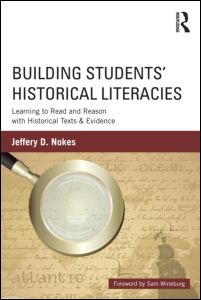
A Reading that Has Helped Change my View of History Education: Nokes' Learning to Read and Reason

Book Review by Cynthia Wallace-Casey,
PhD Candidate
University of New Brunswick
(Fredericton)

Picture this:
"Ms. Cordova, the principal at McArthur Middle School, walks down the hall of the social studies department during third period. She notices the lights are off in Mr. Hanks’ classroom and, glancing in, observes that he is showing students a video. Most students are filling out a worksheet. Ms. Cordova is distracted by loud voices coming from the next classroom down the hall. As she approaches, she hears students reciting in unison the names of the presidents of the United States in chronological order… Finally Ms. Cordova sees Mr. Rich’s classroom, the class she has come to observe. As she enters, students’ behaviour appears somewhat chaotic… As Ms. Cordova approaches, Mr. Rich nervously welcomes her, inviting her to join the students’ discussions. Students pay little attention to her. They are looking at a black and white photograph of children working in a textile mill..." (Noke, 2013, p.3)

These words are drawn from the opening passage of Jeffrey Nokes’ publication Building Students’ Historical Literacies: Learning to Read and Reason with Historical texts and Evidence (2013). Having completed 13 weeks of fieldwork with a class of seventh-graders (exploring the role of evidence and sources in history education), I see great relevancy in Nokes’ words.

Through "quasi-autobiographical" vignettes that set the stage for each chapter, we enter into the world of the classroom teacher. In this way we are able to empathise with the challenges—as well as rewards—teachers face in integrating Historical Thinking concepts into history education. Indeed, as both Ronald Martinello and David Bussel have confided, the transition from a "Mr. Hanks" to a "Mr Rich" is not an easy task. Reflecting back on my own (relatively brief) classroom experience, such a transition in learning culture can be challenging at best; Nokes, however, demonstrates how it can be done.