My recent publication in the Yearbook of the International Society for History Didactics, Volume 40, 2019, pp. 131-199:
In this journal article I explore student-constructed narrative interpretations of Canada’s History Hall. Drawing from an empirical investigation that included student visitors, as well as adult facilitators at the Canadian Museum of History, I reveal the “big ideas” that students (n=26) constructed about Canada’s past, and how these related to their museum experience.
This inquiry is part of a larger investigation (supported by the Social Sciences and Humanities Research Council) that explores: 1) how the Canadian History Hall represents such difficult topics in history as First Nation settler colonial experiences and Residential Schools; 2) the national narratives that students construct from such a learning experience; and 3) the potential role for museum spaces in enabling Historical Thinking. Read more...
Showing posts with label Historical Thinking. Show all posts
Thursday, March 12, 2020
Sunday, January 21, 2018
Language Rights and Place-based History Education
![]() |
Image credit: Government of Canada,
Department of Justice
|
SSHRC Postdoctoral Research Fellow
University of Ottawa
As the only officially bilingual province in Canada, New Brunswick holds a unique position regarding history education and collaborative curriculum development. In this province, it is as if we stand between two linguistic divides—with one foot firmly planted in English-speaking Canada, and the other confidently placed within a French-speaking world. This is because, unlike other provinces and territories in Canada, New Brunswick maintains two distinct education systems that are separate and equal. This distinction is not just a privilege, but a right: a right that is firmly embedded within our Charter of Rights and Freedoms. As indicated in section 16.1 of the 1982 Constitutional Act of Canada:
(1) The English linguistic community and the French linguistic community in New Brunswick have equality of status and equal rights and privileges, including the right to distinct educational institutions and such distinct cultural institutions as are necessary for the preservation and promotion of those communities.
2) The role of the legislature and government of New Brunswick to preserve and promote the status, rights and privileges referred to subsection (1) is affirmed.In this sense, education and cultural identity operate hand-in-hand. For each linguistic group, school is not simply about “making the grade,” it is about preserving and promoting social responsibility to two linguistic communities. This educational philosophy is supported by the Council of Atlantic Ministers of Education and Training (CAMET), as well as the Council of Education Ministers of Canada (CEMC). More specifically, the Pan-Canadian French as a First Language Project (2002, 2012) of CEMC clearly articulates this belief. It recognizes that language is not just a communication tool, but also a thinking, learning, and identity-building tool (CEMC, 2002, p. 3).
How such dynamics play out within New Brunswick’s social studies curriculum, is through respect for regionalism and diversity. Regionalism, in that New Brunswick joins with like-minded provinces to share curriculum resources; and diversity, in that the province’s two curriculum narratives reflect distinctions within New Brunswick’s linguistic communities.
Sunday, October 15, 2017
Monday, February 15, 2016
Book Review: Family Ties by Andrea Terry (or More on the Challenges of Teaching with Museums)
By Cynthia Wallace-Casey, PhD
University of New Brunswick
(Fredericton)
There’s something about the experience of a Victorian Christmas that makes many of us feel warm and fuzzy inside. Our sense of nostalgia seems heightened by the festive season. Because of this, perhaps we’re more prone to let down our critical lens on the past, and simply enjoy the visual candy. Surrounded by the sights, sounds, and smells of the season, we encounter compelling evidence to suggest that we can truly experience the past for real… as it once was.
Andrea Terry, however, in her publication Family Ties: Living History in Canadian House Museums (2015), dispels such nostalgia, as she closely examines the annual Victorian Christmas programs at three Canadian house museums: Dundurn Castle in Hamilton Ontario, Sir George-Étienne Cartier National Historic Site in Montreal Quebec, and William Lyon Mackenzie House in Toronto Ontario. With a keen eye for cultural hegemony, Family Ties delves down beneath the sugary surface, to reveal how interpretive Christmas programs in each of these living history museums are actually a product of present-day values, place-based politics, and nationalistic agendas.
University of New Brunswick
(Fredericton)
There’s something about the experience of a Victorian Christmas that makes many of us feel warm and fuzzy inside. Our sense of nostalgia seems heightened by the festive season. Because of this, perhaps we’re more prone to let down our critical lens on the past, and simply enjoy the visual candy. Surrounded by the sights, sounds, and smells of the season, we encounter compelling evidence to suggest that we can truly experience the past for real… as it once was.
Andrea Terry, however, in her publication Family Ties: Living History in Canadian House Museums (2015), dispels such nostalgia, as she closely examines the annual Victorian Christmas programs at three Canadian house museums: Dundurn Castle in Hamilton Ontario, Sir George-Étienne Cartier National Historic Site in Montreal Quebec, and William Lyon Mackenzie House in Toronto Ontario. With a keen eye for cultural hegemony, Family Ties delves down beneath the sugary surface, to reveal how interpretive Christmas programs in each of these living history museums are actually a product of present-day values, place-based politics, and nationalistic agendas.
Wednesday, December 16, 2015
The Challenges of Teaching with Museums
By Cynthia Wallace-Casey, PhD
University of New Brunswick
(Fredericton)
Did you know that there are more than 1,500 museums in
Canada? Museums encompass many
disciplines of study, including history, science, nature, and the arts. Their collections range from tangible objects
to intangible ideas, and their methods of presentation range from static
displays to participatory environments.
From a pedagogical point of view, museums present rich
learning environments, where constructed narratives are communicated through
the use of sight, sound, touch, smell, and emotion. Within such narrative constructs, as
Trofanenko and Segall (2014) have pointed out, pedagogy is often positioned “to
assume particular assumptions, perspectives, and views about the world and its
people” (p. 1). In this sense, while
museums can provide powerful sites for learning, they can also be exclusionary
and restrictive.
As teaching tools, museums also present their own
distinct challenges. This is because what
constitutes learning in a museum involves multiple sensory experiences, personal
interaction, and extended learning outcomes that change over time. For this reason, learning in a museum is seldom
immediately apparent or easily assessed (Wertsch, 2002, p. 114; see also Falk
& Dierking, 2000; Kelly, 2011; Wallace-Casey, 2013). Falk and Dierking’s (2013) Contextual Model of Learning, identifies
four broad contexts for analyzing learning in a museum setting: personal,
sociocultural, physical, and temporal. Such
a model also acknowledges (regardless of age or subject discipline) that
“Learning begins with the individual. Learning involves others. Learning takes
place somewhere” (Falk & Dierking, 2002, p. 36), and learning continues
over time (Falk & Dierking, 2013). This model, while reminiscent of constructivist
pedagogy, recognises the complex nature of learning in a museum, and calls for
more robust measures for assessment that extend beyond mere appropriation of a
desired narrative claim.
Tuesday, November 17, 2015
Student Narratives and Public Memory in Museums
University of New Brunswick
(Fredericton)I would like to draw your attention to a history education symposium coming up on December 1 in London (England) at the Institute of Education. This seminar series brings together three international scholars to explore what young people know about the past and their sources of knowledge.
Dr. Jocelyn Letourneau, of Laval University (Quebec), will discuss a pragmatic approach to teaching history, intended to move students “outside the thinkable they’ve been accustomed to in living in a particular society and being subject to its broad representations.”
Dr. Arie Wilschut, of the Amsterdam University of Applied Sciences, will focus his discussion on the Dutch national historical consciousness, in particular, “we” versus “they” perspectives when talking and writing about the past.
Dr. Stéphane Levesque, of the University of Ottawa, will discuss the function of narration in orientating a community (and the individuals who share a membership in that community) within the context of time and nation.
Saturday, June 20, 2015
De-constructing Cabinets of Curiosity: Arts-based Inquiry Project in Historical Thinking
PhD candidate
University of New Brunswick
(Fredericton)This arts-based inquiry project was intended to complement and extend upon my PhD research, regarding how a heritage community can assist middle school students in deepening their historical consciousness. This activity specifically related to the photovoice component of my research. It was intended to serve two purposes: a) to extend and disseminate my research to a broader public audience, by facilitating the development of a gallery-style photo exhibition that illustrates students’ abilities (through their eyes and in their words) of engaging in historical inquiry within a local history museum; and b) to reveal the nature of their ability to think historically in a museum
setting.
Read my full report here...
Monday, March 23, 2015
Using artifacts to teach social studies: What’s the story?
PhD candidate
University of New Brunswick
(Fredericton)
In the interest of expanding upon my previous blog contributions, I’d like to introduce you to a project I’m currently working on, which involves object-based learning. Collaborating with a provincial history museum (The New Brunswick Sports Hall of Fame), we are currently developing a unit of study that focuses specifically upon artifacts, sport, and war. Through a series of six lesson plans, teachers will be able to access a variety of primary and second sources, to compare and extend upon the artifact source, and thus reconstruct a “story” around each individual owner. This involves adopting a particular disciplinary approach to the past, which is commonly referred to as “material history” or “material culture.”
Material history, as often practiced in object-centered history museums, represents a unique approach to historical inquiry. As Hood (2009) has pointed out, “most historians are not equipped to do object-centered research” (p.177). For this reason, the challenge of “reading” an object that does not contain words, can be daunting for most anyone, if they have not learned the craft of material history inquiry.
With my own dissertation research involving seventh grade students, I found that participants particular enjoyed the sense of unbridled wonder that came from approaching their museum as a collection source. Object-based inquiry, although challenging for all, was also doable by all. Students quickly picked up on the technique, and in the process broke away from the official museum story, to create their own sense of meaning – a meaning that was grounded in evidence.
Tuesday, January 20, 2015
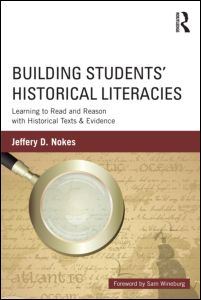
A Reading that Has Helped Change my View of History Education: Nokes' Learning to Read and Reason
Book Review by Cynthia Wallace-Casey,
PhD Candidate
University of New Brunswick
(Fredericton)
Picture this:
These words are drawn from the opening passage of Jeffrey Nokes’ publication Building Students’ Historical Literacies: Learning to Read and Reason with Historical texts and Evidence (2013). Having completed 13 weeks of fieldwork with a class of seventh-graders (exploring the role of evidence and sources in history education), I see great relevancy in Nokes’ words.
Through "quasi-autobiographical" vignettes that set the stage for each chapter, we enter into the world of the classroom teacher. In this way we are able to empathise with the challenges—as well as rewards—teachers face in integrating Historical Thinking concepts into history education. Indeed, as both Ronald Martinello and David Bussel have confided, the transition from a "Mr. Hanks" to a "Mr Rich" is not an easy task. Reflecting back on my own (relatively brief) classroom experience, such a transition in learning culture can be challenging at best; Nokes, however, demonstrates how it can be done.
PhD Candidate
University of New Brunswick
(Fredericton)
Picture this:
"Ms. Cordova, the principal at McArthur Middle School, walks down the hall of the social studies department during third period. She notices the lights are off in Mr. Hanks’ classroom and, glancing in, observes that he is showing students a video. Most students are filling out a worksheet. Ms. Cordova is distracted by loud voices coming from the next classroom down the hall. As she approaches, she hears students reciting in unison the names of the presidents of the United States in chronological order… Finally Ms. Cordova sees Mr. Rich’s classroom, the class she has come to observe. As she enters, students’ behaviour appears somewhat chaotic… As Ms. Cordova approaches, Mr. Rich nervously welcomes her, inviting her to join the students’ discussions. Students pay little attention to her. They are looking at a black and white photograph of children working in a textile mill..." (Noke, 2013, p.3)
These words are drawn from the opening passage of Jeffrey Nokes’ publication Building Students’ Historical Literacies: Learning to Read and Reason with Historical texts and Evidence (2013). Having completed 13 weeks of fieldwork with a class of seventh-graders (exploring the role of evidence and sources in history education), I see great relevancy in Nokes’ words.
Through "quasi-autobiographical" vignettes that set the stage for each chapter, we enter into the world of the classroom teacher. In this way we are able to empathise with the challenges—as well as rewards—teachers face in integrating Historical Thinking concepts into history education. Indeed, as both Ronald Martinello and David Bussel have confided, the transition from a "Mr. Hanks" to a "Mr Rich" is not an easy task. Reflecting back on my own (relatively brief) classroom experience, such a transition in learning culture can be challenging at best; Nokes, however, demonstrates how it can be done.
Labels:
historical literacy,
Historical Thinking
Saturday, November 29, 2014
Mapping the Historical Consciousness of 7th Graders.
by Cynthia Wallace-Casey,
PhD Candidate
University of New Brunswick
(Fredericton)
At the risk of self-promotion, I would like to draw your attention to a research note that has just been published in the Journal of New Brunswick Studies. As a graduate student who has devoted the past 5 years to exploring the phenomenon of historical consciousness, I am (needless-to-say) thrilled and honoured to see a small piece of my research published in a scholarly journal.
PhD Candidate
University of New Brunswick
(Fredericton)
At the risk of self-promotion, I would like to draw your attention to a research note that has just been published in the Journal of New Brunswick Studies. As a graduate student who has devoted the past 5 years to exploring the phenomenon of historical consciousness, I am (needless-to-say) thrilled and honoured to see a small piece of my research published in a scholarly journal.
All this
aside, the findings also warrant further discussion, since they provide an
intriguing glimpse into an age group less commonly discussed in conversations
around historical consciousness and historical thinking in Canada. The data was
collected as part of a pre-survey that expanded upon the Canadians and their Pasts (2013) investigation with an entire class
of Anglophone 7th graders. In
working with this group of students, I had the privilege of learning a little
bit more about their relationship with the past, and the narratives that they
carry. Over a period of 15 weeks, we worked together to explore a material
history framework for historical thinking in museums, which served as a
cultural tool for deepening students’ historical consciousness.
As Stéphane Levesque (2014) has pointed out, “the study of historical consciousness makes
it possible to understand how people use
the past.” For the students participating in this inquiry, it was evident that
they initially used the past to
situate themselves within a Canada narrative of privilege and war. These “broad
pictures” for remembering represented common themes that (just as Levesque has indicated) served
as “backdrops” for acquiring new knowledge. For these students, their themes of
privilege and war were predominantly optimistic.
In somewhat contradiction to this optimism, however, many
of the students paralleled this schema with more pessimistic perceptions about
change over time. In this regard the students were very unlike adult samplings
in the larger Canadians and Their Pasts
study. Hence, rather than perceiving things as getting better over time, nearly
half (42%) of the students recognised progression as a contradiction. For these
students, while technology had made life easier, the resulting pollution and
conflict had also made life worse. In this sense, students’ narratives of
privilege seemed to be somewhat at odds with their beliefs in change over time.
Tuesday, November 4, 2014
Adapting Documents for the Classroom: Equity and Access
Source:
Teaching History.org
Read more..
.
Teaching History.org
What Is It?
Preparing and modifying primary source documents
so that all students can read and analyze them in their history classrooms.
Rationale
Although they are useful for engaging students in
the past, and teaching them to think historically, primary source documents
often use antiquated or complex language. This can pose a challenge even for
able readers, let alone those who read below grade level. Adapting a variety of
historical documents for use in the classroom will allow students greater
access to important reading and thinking opportunities.
Description
Adapting documents for the classroom includes the
use of excerpts, helpful head notes, and clear source information. It means
adjusting documents for non-expert readers and making them shorter, clearer,
and more focused. Adaptations can also include simplifying syntax and
vocabulary, conventionalizing punctuation and spelling, cutting nonessential
passages, and directing attention to a document's key components.
Read more..
.
Is it Ever Okay to Tamper with the Past? Modifying Primary Sources to Make Them Accessible
History Tech
by glennw on October 27, 2014
Maybe this is not as big a topic as I think it is. Maybe it’s just
me. But it seems as if the idea of modifying primary sources in order to make
them more “user friendly” for our students, especially younger kids, is kind of
a big deal.
Maybe I’m wrong. As I travel around the country, I get the chance
to work with lots of social studies teachers – who by the very nature of their
position have a tendency to voice strong opinions about, well . . . just about
everything.
Including among other
things: K-State football, KU basketball, Democrat, Republican, Texas BBQ, Kansas
City BBQ, and iPads vs. Chromebooks.
Tuesday, September 16, 2014
Taking Time for Role Reversals in Museums
PhD Candidate
University of New Brunswick
(Fredericton)
One of the biggest challenges I've encountered when working with both adults and students in community history museums, is the problem of time. There never seems to be enough time to make connections: connections with student visitors, connections to individual artifacts, connections to big ideas in history. Too often it seems, a school field-trip to a community museum evolves into little more than a hurried walk through history, where students are presented with only the alluring highlights of each exhibit space. Although armed with the best of intentions, in such instances museum educators become little more than information gatekeepers, adjusting their tour ‘on the fly’ to the immediate needs of a group leader—without any prior knowledge of the students or their interests. For students themselves, such a scenario leaves no time to ask questions, no time for individual engagement, and no time to establish historical connections.
There is a solution to this, however, and it rests with role reversals,
along with repeat museum visits. As I have found in my own research, with
repeat visits to a community history museum (combined with curatorial classroom
time) traditional gatekeeper roles can be reversed—thus ‘flipping the
museum’—to enable student-driven exploration of the past. In my own case study,
students visited their local community history museum four times over six
weeks. In between, they also re-visited their experience through classroom
activities, which included close reading (and corroboration) of artifact
sources, as well as mapping of museum narratives. In this way, students were
empowered to break out of their passive role as knowledge-receivers—to become
engaged in discovery, observation, de-construction, and re-interpretation.
By returning to the museum over an extended unit of study, students
benefited from having ample time to establish thoughtful connections within the
museum. In addition, with each repeat visit, role reversals became increasingly
more evident, as students themselves adopted the social role of museum
curators. Thus, arriving at the museum for their first visit, students
attentively followed the guide, listening to the words and taking notes.
Arriving for the second visit, it was obvious that all of the students were now
eager and prepared to engage in dialogue with the exhibits, as well as the
curators. They were focused, familiar with the site, and armed with a mission.
This sense of purpose continued with each return, as students became increasing
more accustomed to the learning environment, and seized upon each opportunity
to direct probing questions of the curators. By the fourth and final museum
visit, it was clear that museum roles had been flipped, since instead of simply
following the guide and taking notes (as had been the case during their first
visit), students were now fully in charge of the tour—with each presenting
curatorial statements of significance about their chosen artifact, while the
adult audience simply listened. This reversal process proved to be very
effective,
Wednesday, August 6, 2014
Using History to Invigorate Common-Core Lessons - by Sam Wineburg
Education Week - December 10, 2013
By Sam Wineburg
Common-core anxiety sweeps the land, and professional developers of curriculum and assessment smell dollars. Flashy brochures promise that once that purchase order is signed, every child will pass the new tests. For a pittance more, they'll make the lion lie down with the lamb.
District administrators would be wise to lay down their pens. There's a valuable resource right in front of their eyes. It requires no lengthening of the school day, no elimination of art and music, and no endorsement of checks to third-party developers. It's so familiar we no longer notice it. It's called the history/social studies ...
Read more...
Labels:
Common-core Standards,
Historical Thinking
Sunday, May 4, 2014
Keeping it Real.
The recent announcement of a name change for
Canada’s Museum of Civilization has sparked a great deal of public debate in
Canada. It all began, when Heritage Minister, James Moore, first announced the idea
in 2012,
as part of a departmental branding initiative. In anticipation of Canada’s upcoming
150th anniversary of Confederation, funding priorities are being directed
towards specific historical benchmarks.
One month after making the announcement, Bill C-49, An Act to amend the Museums Act in order to establish the Canadian Museum of History and to make consequential amendments to other Acts, received first reading in the House of Commons, followed by a second reading in May 2013. Meanwhile, museum consultants launched a cross-Canada engagement campaign, holding roundtable discussions in nine cities, and establishing an online survey for wider participation. By December 2013, the name change became official. The Canadian Museum of Civilization would now be called the Canadian Museum of History.
Tuesday, March 18, 2014
De-Constructing Cabinets of Curiosity: History’s Mysteries in the Museum
by Cynthia Wallace-Casey,
PhD Candidate
University of New Brunswick
(Fredericton)
Building upon this month’s theme of ‘Canadian History’s Mysteries’, I would like to share with you some of my own fieldwork experience regarding museum education and the Historical Thinking concept of Evidence and Sources. This research demonstrates how students can be empowered to not just absorb the narratives they encounter in museums—but rather consider exhibit artifacts as mystery sources waiting to be deciphered.
PhD Candidate
University of New Brunswick
(Fredericton)
Building upon this month’s theme of ‘Canadian History’s Mysteries’, I would like to share with you some of my own fieldwork experience regarding museum education and the Historical Thinking concept of Evidence and Sources. This research demonstrates how students can be empowered to not just absorb the narratives they encounter in museums—but rather consider exhibit artifacts as mystery sources waiting to be deciphered.
Central to this approach to museum education is the understanding
that a discipline-based method for historical inquiry in museums requires a
slightly different set of procedures. This is because history museums are not
like other sites of learning. Curators in history museums become very adept at "reading"
artifacts for their visual clues. Within the museum profession, historians who
have nurtured this ability are called Material Historians. Hence, material
historians are able to read much more than words.
Material historians also
do not see artifacts as props to illustrate
a preconceived idea. Instead, material
historians see artifacts as rich sources of evidence. In this sense,
artifacts represent the starting point
for any historical inquiry – not the end point.
So, how can educators empower middle school students to
think historically within history museums? The
key rests with enabling them to go directly to the artifact. In so doing, students
can learn how to unlock the evidence within each and every source they
encounter.
With this principal in mind, I have adopted a material
history framework that was first formulated by graduate students at the
University of New Brunswick in the early 1980’s. The scaffolding version that was developed for
my research focused upon four basic steps of historical inquiry:
- 1. Describe: Carefully recording any observable evidence the artifact contains;
- 2. Corroborate: Comparing the artifact source (along with exhibit text) against the accession file (and other artifacts within the collection) for additional clues, questions, or contradictions;
- 3. Contextualize: Extending the inquiry to search other secondary sources for additional background information;
- 4. Conclude: Formulating a summary statement about the artifact, based upon findings.
Such a process actually
enables students to de-construct museum
narratives. In the case of my seventh-grade class, it also led to many
unexpected surprises for students; because quite quickly they discovered that the
past is not always as it first appears. Through careful examination of the primary
artifact sources, several students found contradictions within the museum exhibits;
while some uncovered new information; and all experienced the problematic
nature of historical inquiry.
Saturday, February 1, 2014
“I found my grandfather!”: Students researching their family history.
![]() |
| Combing the stacks of the New Brunswick Provincial Archives |
PhD Candidate
University of New Brunswick
(Fredericton)
Last December, the THEN/HiER blog was abuzz with interesting discussions about family history in the classroom. As my colleagues have pointed out, family history can “maximize student engagement and learning” (Maddie Knickerbocker, December 3, 2013); it can “build an enduring and evolving connection to the past” (Heather McGregor, December 5, 2013); it can “serve as entry points into the bigger picture of history” (Kate Ireland, December 12, 2013); and can “open the door of possibility for building research skills” (Jesika Arseneau, December 20, 2013). All of these arguments are valid and worthy. They speak of history as a construct of the beholder—assembled from traces and accounts—that, with a little bit of guidance, might enable students to re-construct the narratives that frame their lives. With each of these arguments, however, the writers have concluded their entry with a challenging question. This is what I would like to address.
This month, I have been given the rare opportunity to work with a group of 11 middle school students, helping them to research their family history. This practicum has evolved out of my dissertation, which relates to ways in which middle school students remember their past. Hence, as part of a school-wide enrichment program, one morning a week, over the next four weeks, I will be attempting to integrate family histories into students’ social studies. I’d like to share with you my experience of leading this group of students through the archival maze of family identities. In so doing, I hope to add to the discussion around benefits and challenges associated with this approach to history education.
Because family history research can be equated to looking for a needle in a haystack, I have organized my lesson plans around four broad themes: What I already know; What I want to know; What I can find out; and What I have learned. As a result, the students are being requested to undertake a bit of family sleuthing each week; expand upon these clues by consulting primary sources in the archives or online; and draw meaning from the subsequent evidence they discover. The final project will involve creating a memory book that documents what they have found, what it means to the individual, and how it connects to larger events in Canadian history. Such an approach is not without its challenges however.
First of all, it is important to remember that for these students, “history” is anything that has happened before their birth, and “the past” includes memories of their own childhood. So, in this sense, family history means working backwards from their birth, in approximately the year 2000. Likewise, when they speak of their grandparents, they are referencing a birth-range between c. 1940 to 1960. This poses a challenge, because, although many of the students have wonderful stories to tell about their family’s distant past (stories that have been handed down through the generations), it is extremely difficult to engage in archival research unless they have a specific name and a specific date with which to work. To make matters worse, in many provinces, records of birth for this time period are not available (unless one wishes to pay a fee and wait several months for a written response). So, in such cases, vague references to grandparents are all that we have to begin with. Telephone directories (available on ancestry.ca) are proving to be extremely valuable for this purpose, because they enable students to make that first connection with a past that stretches beyond their immediate memory (although even this source is not universally beneficial to all students). Ultimately then, my first challenge is to help each student to find someone in their family who was born before 1922, because with this information they can tap into the most recently available census returns of 1921.
Secondly, although I am only working with 11 students (and assisted by a parent volunteer), undertaking this type of activity with an entire class would be extremely difficult. Not impossible however, and not unfeasible either; because, with the appropriate scaffolding tool anything is possible. What I am finding, is that scaffolding tools are required that can be quickly adjusted to meet the specific learning needs of each individual student—as their unique research problem arises; and although there are endless streams of generic teaching resources to be found on the Internet, with exception to the tools developed by Library and Archives Canada (which provide a good start), very few Internet resources actually enable students to engage in serious research that is both genealogical and historical in nature.
So, in order to sift through the haystack of records available online, while also accommodating diversity in prior knowledge along with learning differentiations, I have found it necessary to design tools that enable every individual student to unlock a ‘clue’ about their unique past, from a large variety of archival sources. This is no small feat, since the online archival sources for each province within Canada are woefully inconsistent, and knowledge of digital records in other jurisdictions (outside of Canada) require an expertise that I do not possess. Hence, my second challenge is to ensure that no student be excluded from the inquiry process; and that every student experience success (in some way) of finding something relating to their family.
Undoubtedly—and very unlike the popular television advertisements, in which one click of a mouse opens the doors to your past—these students are discovering that there are no easy answers. Instead, they are learning that family history research requires precise examination, perseverance, patience, and meticulous record-keeping. Along the way, they are also experiencing (first-hand) how historians ‘piece together’ the past from seemingly minuet scraps of evidence. Yet, at the same time, they are reaping great satisfaction; because within those eureka moments—when someone pipes out: “I found my grandfather!”—they are beginning to feel exactly what it’s like to be a researcher. These are the real-life moments that, in the words of Ted Christou (2010), confirm history to be “sometimes messy, often tentative, secretively delightful, and wonderfully exciting”.
I look forward to sharing our journey with you…
References:
Ancestry.ca (February 1, 2014). Ancestry.ca. Retrieved from http://home.ancestry.ca/?o_iid=41014&o_lid=41014&o_sch=Web+Property
Arseneau, J. (December 20, 2013). Family history as a gateway to learning about archives [Web blog post]. Retrieved from http://thenhier.ca/en/content/family-history-gateway-learning-about-archives
Christou, T. (2010). “Get thee to the archive: The teaching of history and the doing of history”. Education letter: A publication of the faculty of education and the education alumni committee. Fall/Winter, 15-17.
Ireland, K. (December 12, 2013).Considering family histories in the elementary classroom [Web blog post]. Retrieved from http://thenhier.ca/en/content/considering-family-histories-elementary-classroom
Knickerbocker, M. (December 3, 2013). Family histories in the colonial classroom [Web blog post]. Retrieved from http://thenhier.ca/en/content/family-histories-colonial-classroom
Library and Archives Canada (February 1, 2014). Genealogy and family history: Youth corner. Retrieved from http://thenhier.ca/en/content/family-histories-colonial-classroom
McGregor, H. (December 5, 2013).Using identity, family history and family artifacts to connect with the past [Web blog post]. Retrieved from http://thenhier.ca/en/content/using-identity-family-history-and-family-artifacts-connect-past
Ancestry.ca (February 1, 2014). Ancestry.ca. Retrieved from http://home.ancestry.ca/?o_iid=41014&o_lid=41014&o_sch=Web+Property
Arseneau, J. (December 20, 2013). Family history as a gateway to learning about archives [Web blog post]. Retrieved from http://thenhier.ca/en/content/family-history-gateway-learning-about-archives
Christou, T. (2010). “Get thee to the archive: The teaching of history and the doing of history”. Education letter: A publication of the faculty of education and the education alumni committee. Fall/Winter, 15-17.
Ireland, K. (December 12, 2013).Considering family histories in the elementary classroom [Web blog post]. Retrieved from http://thenhier.ca/en/content/considering-family-histories-elementary-classroom
Knickerbocker, M. (December 3, 2013). Family histories in the colonial classroom [Web blog post]. Retrieved from http://thenhier.ca/en/content/family-histories-colonial-classroom
Library and Archives Canada (February 1, 2014). Genealogy and family history: Youth corner. Retrieved from http://thenhier.ca/en/content/family-histories-colonial-classroom
McGregor, H. (December 5, 2013).Using identity, family history and family artifacts to connect with the past [Web blog post]. Retrieved from http://thenhier.ca/en/content/using-identity-family-history-and-family-artifacts-connect-past
Tuesday, October 22, 2013
History Wars Revisited: A Discussion on Battle Lines in Teaching about War in the Classroom
by Cynthia Wallace-Casey,
PhD Candidate
University of New Brunswick
(Fredericton)
I recently had the opportunity to attend a public lecture sponsored by the Gregg Centre for the Study of War and Society, held at the Beaverbrook Art Gallery in Fredericton, on October 15. Guest speaker was Alan Sears, PhD, Professor of Education at the University of New Brunswick, and member of the Executive Board of THEN/HiER. His presentation was entitled “Battle Lines in the Schools: Teaching the History of War and Society for the Common Good”.
This was the first in a series of public lectures, hosted each fall by the Gregg Center. Sears seemed happily in his element, as he challenged the audience to reconsider their own pre-conceived beliefs about why teach students about War.
Harkening back to the History Wars of nearly 20 years ago, Sears commenced by outlining how the “what” of history has long been a point of contention in many countries (including Canada), particularly when it comes to War. Rather than obsessing about what narrative would be “good” for students, Sears argued, our efforts are better spent focussing upon the “how” behind such narratives. In this way, he reasoned, the “competing visions” of War can provide ample opportunities for engaging students in the on-going heated debates that are central to any democracy.
Sears described the "Battle Lines" of teaching about War as drawn between two extremities. On one side stands the “three cheers” approach to history education, epitomised by J.L. Granatstein’s (1998) highly controversial polemic, Who Killed Canadian History, which positions War as front and centre in nation-building. On the other side, stands the “social cohesion” approach to history education, exemplified by Margaret Conrad and Alvin Finkel’s (2008) two volume History of the Canadian People, in which War takes a back seat to other social factions.
Why teach the history of War in the classroom? Sears responded to this question with four clearly articulated reasons as to why NOT. We should not, he said, teach about War in order to simply:
Alternatively, Sears challenged the audience to consider War as an educational tool for engaging students in the messiness of democratic ideals. In this sense, he explained, the debates can remain ever fluid, ever contested, ever open to an expanded view of humanity.
Indeed, much of Sear’s theoretical argument has been outlined within his chapter in the publication New Possibilities for the Past: Shaping History Education in Canada (2011). For this reason, as a preface to listening to his lecture, I’d recommend that you read his chapter, in order to gain a fuller understanding of how Sears has aligned Historical Thinking with Citizenship Education. Drawing heavily from the Common Good paradigm of Keith Barton and Linda Levstick (2008), Sears has argued that history and citizenship work hand-in-hand, fostering democracies that are “participatory, pluralistic, and deliberative” (p. 355). These principles of citizenship education lingered within his lecture of October 15.
After having torn down the aforementioned political reasons for teaching about War, Sears brought his audience back to the central question: Why teach the history of War and society in the classroom?
To this, he presented 7 bold reasons as to why the topic of War can contribute to a student’s vision of a common good:
A full recording of Professor Sears’ one-hour lecture can be found here:
PhD Candidate
University of New Brunswick
(Fredericton)
I recently had the opportunity to attend a public lecture sponsored by the Gregg Centre for the Study of War and Society, held at the Beaverbrook Art Gallery in Fredericton, on October 15. Guest speaker was Alan Sears, PhD, Professor of Education at the University of New Brunswick, and member of the Executive Board of THEN/HiER. His presentation was entitled “Battle Lines in the Schools: Teaching the History of War and Society for the Common Good”.
This was the first in a series of public lectures, hosted each fall by the Gregg Center. Sears seemed happily in his element, as he challenged the audience to reconsider their own pre-conceived beliefs about why teach students about War.
Harkening back to the History Wars of nearly 20 years ago, Sears commenced by outlining how the “what” of history has long been a point of contention in many countries (including Canada), particularly when it comes to War. Rather than obsessing about what narrative would be “good” for students, Sears argued, our efforts are better spent focussing upon the “how” behind such narratives. In this way, he reasoned, the “competing visions” of War can provide ample opportunities for engaging students in the on-going heated debates that are central to any democracy.
Sears described the "Battle Lines" of teaching about War as drawn between two extremities. On one side stands the “three cheers” approach to history education, epitomised by J.L. Granatstein’s (1998) highly controversial polemic, Who Killed Canadian History, which positions War as front and centre in nation-building. On the other side, stands the “social cohesion” approach to history education, exemplified by Margaret Conrad and Alvin Finkel’s (2008) two volume History of the Canadian People, in which War takes a back seat to other social factions.
Why teach the history of War in the classroom? Sears responded to this question with four clearly articulated reasons as to why NOT. We should not, he said, teach about War in order to simply:
- Create historians or students of history;
- Foster love of nation;
- Imagine a nation that should have been;
- Commemorate the fallen.
Alternatively, Sears challenged the audience to consider War as an educational tool for engaging students in the messiness of democratic ideals. In this sense, he explained, the debates can remain ever fluid, ever contested, ever open to an expanded view of humanity.
Indeed, much of Sear’s theoretical argument has been outlined within his chapter in the publication New Possibilities for the Past: Shaping History Education in Canada (2011). For this reason, as a preface to listening to his lecture, I’d recommend that you read his chapter, in order to gain a fuller understanding of how Sears has aligned Historical Thinking with Citizenship Education. Drawing heavily from the Common Good paradigm of Keith Barton and Linda Levstick (2008), Sears has argued that history and citizenship work hand-in-hand, fostering democracies that are “participatory, pluralistic, and deliberative” (p. 355). These principles of citizenship education lingered within his lecture of October 15.
After having torn down the aforementioned political reasons for teaching about War, Sears brought his audience back to the central question: Why teach the history of War and society in the classroom?
To this, he presented 7 bold reasons as to why the topic of War can contribute to a student’s vision of a common good:
- It is significant: Because War has impacted so many people, in so many different ways, and continues to be a threat to the safety and wellbeing of so many people worldwide, its’ role in past, present, and future cannot be ignored;
- It is iconic: The timelessness of ‘man’s inhumanity to man’ transcends all social, political and pedagogical barriers. Regardless of one’s own beliefs, the profundity of War can make for a highly effective learning opportunity;
- It is contested: The battle lines that have been drawn around the teaching of War, are, in themselves, a good thing. This is because the contentious nature of War actually enables students to be actively engaged in deliberations that are characteristic of any democratic society;
- It is multilayered and complex: The history of War can (and should) be approached from many different angles and historiographical positions. In this way, the topic is never one-dimensional, and there are never any easy answers;
- It takes us beyond ourselves: It is important to remember that Canada was part of an alliance of nations. War involves individuals acting within the broader context of many people, many nations, and many political fronts;
- It is accessible: War touches upon local communities and local history, so it provides an effective way of placing localities within the broader context of world events;
- It is unfinished: The study of War enables students to participate in historical questions that are not already answered. War is constantly open to re-examination, as new sources of evidence become available to the classroom, and as world events impact our perspective upon the past.
A full recording of Professor Sears’ one-hour lecture can be found here:
Monday, April 29, 2013
“Because, although I don't know much about it now, I really want to know more about my family.”
by Cynthia Wallace-Casey,
PhD Candidate
University of New Brunswick (Fredericton)
After 15 adventuresome weeks of classroom fieldwork, I am nearing the end of the data collection phase of my research. It’s been an invigorating experience, working with a group of 5 community history museum volunteers, as well as 24 grade seven students, and their teacher, to explore how a heritage community can assist middle school students in deepening their historical consciousness. By “deepening”, of course, I am referring to Jörn Rüsen’s (1993, 2004) typology of historical consciousness—in particular, what Rüsen has labeled as a “genetic” sense of how we know what we [think we] know, and how this relates to our temporal relationship with the past.
Through my research, I am particularly interested in exploring how 12 - 13 year-olds perceive the concept of “truth” in history; and in turn, how they may be empowered to reach their own understandings about the past, using museum collections as tools for historical thinking. As a result, I have adopted a phenomenological single case study design (Yin, 2009) that is bounded by time, as well as by the formal arrangement of a seventh-grade classroom, and a specific community history museum fieldwork experience.
In this blog entry, it is not my intention to discuss the details of the fieldwork experience. Instead, I’d like to reveal to you a little bit about the importance my students place upon the past.
At the outset of developing my research design, I pondered whether this particular case study could be considered “typical” or “exceptional” of other Canadians. As Bent Flyvberg (2001) has asserted, both breadth and depth are necessary elements of research (p. 87). Hence, Flyvberg has argued, both are equally valuable, because both work hand in hand “for a sound development of social science” (p. 87). Since I have found this argument to be very compelling, when developing my research design, I turned to the well-known national survey Canadians and Their Pasts to establish breadth against which I could compare my case study of seventh-graders.
Launched in 2006 (with data collection completed in 2011), Canadians and Their Pasts, represents an elaborate alliance of 7 academic researchers, 19 collaborators, 6 universities, and 15 community partners, for the purpose of “exploring the role that history plays in the lives of Canadian citizens” (Canadians and Their Pasts, 2012). In the subsequent survey, participants were asked questions designed to: 1) measure levels of general interest in the past; 2) identify activities participants engage in that relate to the past; 3) probe how these activities aid in their understanding of the past; 4) measure the perceived trustworthiness of specific sources of information; 5) probe the relative importance of various pasts; and 6) identify participants’ individual sense(s) of the past (Conrad et al., 2007; Muise, 2008). The resulting data provides a rich profile about what adult Canadians (18 years and older) think about the past, and the role of specific sources of information in shaping their thinking.
Adopting the exact same set of survey questions as Canadians and Their Pasts, I began my phenomenological case study in January, by administering these questions to all of the case study participants. For the purposes of this blog entry, I will limit my discussion to items 1 and 5 of the original survey. Let me tell you a little bit about my seventh-graders…
With regard to interest in history, the largest majority (63%) of the 12 - 13 year-olds reported that they are somewhat interested in history. This figure is slightly above Canada’s national adult average of 50% (Conrad et al, 2010), which might suggest that more than most of the students occupy the ambiguous position of having a budding interest in history (that perhaps could just as easily be nurtured or squashed at this point in their education). It is also interesting to note that by contrast, only 18% are very interested in history. This figure places my students well below the national adult average of 34%.
With regard to the relative importance of various pasts, an overwhelming majority (69%) of the 12-13 year-olds reported that the past of their family is most important to them. This is distantly followed by the past of their country Canada (10%), and their ethnic or cultural group (7%). Students’ explanations for placing such an importance upon family past ranged from such reasoning as “Because I love my family”; to “Because I want to follow them…”; and “Because, although I don't know much about it now, I really want to know more…”. These survey figures, while slightly higher than the national adult Canadian average, are not significantly different, since 54.5 % of Canadians also place the past of their family as most important to them; while the past of their country Canada (6.5%), as well as that of their ethnic or cultural group (6.5%), remain equally lower than the student average. Interestingly, what sets my students apart from other Canadians, however, is that none of these individuals (0%, versus a national average of 3.5%) considered the past of their province as important. They also did not seem to possess any concept of a regional identity.
As to how these findings relate to historical consciousness is another discussion for another day. Also of note is how my students perceive “truth” and complexity within history. In the interest of providing you with a little carrot… preliminary findings certainly suggest that, like many Canadians, these students believe that museums will present them with the truth about what happened in the past… But such discussions must wait for another day. Currently, I am looking forward to conducting a post-survey with the students, to see how their perceptions of history and the past may (or may not) have changed as a result of the experience of doing historical thinking with a museum collection.
PhD Candidate
University of New Brunswick (Fredericton)
After 15 adventuresome weeks of classroom fieldwork, I am nearing the end of the data collection phase of my research. It’s been an invigorating experience, working with a group of 5 community history museum volunteers, as well as 24 grade seven students, and their teacher, to explore how a heritage community can assist middle school students in deepening their historical consciousness. By “deepening”, of course, I am referring to Jörn Rüsen’s (1993, 2004) typology of historical consciousness—in particular, what Rüsen has labeled as a “genetic” sense of how we know what we [think we] know, and how this relates to our temporal relationship with the past.
Through my research, I am particularly interested in exploring how 12 - 13 year-olds perceive the concept of “truth” in history; and in turn, how they may be empowered to reach their own understandings about the past, using museum collections as tools for historical thinking. As a result, I have adopted a phenomenological single case study design (Yin, 2009) that is bounded by time, as well as by the formal arrangement of a seventh-grade classroom, and a specific community history museum fieldwork experience.
In this blog entry, it is not my intention to discuss the details of the fieldwork experience. Instead, I’d like to reveal to you a little bit about the importance my students place upon the past.
At the outset of developing my research design, I pondered whether this particular case study could be considered “typical” or “exceptional” of other Canadians. As Bent Flyvberg (2001) has asserted, both breadth and depth are necessary elements of research (p. 87). Hence, Flyvberg has argued, both are equally valuable, because both work hand in hand “for a sound development of social science” (p. 87). Since I have found this argument to be very compelling, when developing my research design, I turned to the well-known national survey Canadians and Their Pasts to establish breadth against which I could compare my case study of seventh-graders.
Launched in 2006 (with data collection completed in 2011), Canadians and Their Pasts, represents an elaborate alliance of 7 academic researchers, 19 collaborators, 6 universities, and 15 community partners, for the purpose of “exploring the role that history plays in the lives of Canadian citizens” (Canadians and Their Pasts, 2012). In the subsequent survey, participants were asked questions designed to: 1) measure levels of general interest in the past; 2) identify activities participants engage in that relate to the past; 3) probe how these activities aid in their understanding of the past; 4) measure the perceived trustworthiness of specific sources of information; 5) probe the relative importance of various pasts; and 6) identify participants’ individual sense(s) of the past (Conrad et al., 2007; Muise, 2008). The resulting data provides a rich profile about what adult Canadians (18 years and older) think about the past, and the role of specific sources of information in shaping their thinking.
Adopting the exact same set of survey questions as Canadians and Their Pasts, I began my phenomenological case study in January, by administering these questions to all of the case study participants. For the purposes of this blog entry, I will limit my discussion to items 1 and 5 of the original survey. Let me tell you a little bit about my seventh-graders…
With regard to interest in history, the largest majority (63%) of the 12 - 13 year-olds reported that they are somewhat interested in history. This figure is slightly above Canada’s national adult average of 50% (Conrad et al, 2010), which might suggest that more than most of the students occupy the ambiguous position of having a budding interest in history (that perhaps could just as easily be nurtured or squashed at this point in their education). It is also interesting to note that by contrast, only 18% are very interested in history. This figure places my students well below the national adult average of 34%.
With regard to the relative importance of various pasts, an overwhelming majority (69%) of the 12-13 year-olds reported that the past of their family is most important to them. This is distantly followed by the past of their country Canada (10%), and their ethnic or cultural group (7%). Students’ explanations for placing such an importance upon family past ranged from such reasoning as “Because I love my family”; to “Because I want to follow them…”; and “Because, although I don't know much about it now, I really want to know more…”. These survey figures, while slightly higher than the national adult Canadian average, are not significantly different, since 54.5 % of Canadians also place the past of their family as most important to them; while the past of their country Canada (6.5%), as well as that of their ethnic or cultural group (6.5%), remain equally lower than the student average. Interestingly, what sets my students apart from other Canadians, however, is that none of these individuals (0%, versus a national average of 3.5%) considered the past of their province as important. They also did not seem to possess any concept of a regional identity.
As to how these findings relate to historical consciousness is another discussion for another day. Also of note is how my students perceive “truth” and complexity within history. In the interest of providing you with a little carrot… preliminary findings certainly suggest that, like many Canadians, these students believe that museums will present them with the truth about what happened in the past… But such discussions must wait for another day. Currently, I am looking forward to conducting a post-survey with the students, to see how their perceptions of history and the past may (or may not) have changed as a result of the experience of doing historical thinking with a museum collection.
Friday, April 5, 2013
What does historical thinking look like?
(This article has some interesting links to historical thinking resources!)
by glennw on March 26, 2013

Mmm . . . I get this a lot. Especially over the last few months as we’ve rolled out the new proposed social studies standards document for Kansas.
The current document is all about content – with specific indicators that must be taught because they will be on the state-level multiple choice test. And we’ve done a great job over the last decade or so of training our teachers to only worry about whether or not their kids have memorized the tested indicators. The pendulum swung way over to foundational knowledge at the expense of critical thinking... Read more...
by glennw on March 26, 2013
Mmm . . . I get this a lot. Especially over the last few months as we’ve rolled out the new proposed social studies standards document for Kansas.
The current document is all about content – with specific indicators that must be taught because they will be on the state-level multiple choice test. And we’ve done a great job over the last decade or so of training our teachers to only worry about whether or not their kids have memorized the tested indicators. The pendulum swung way over to foundational knowledge at the expense of critical thinking... Read more...
Subscribe to:
Posts (Atom)