Friday, February 17, 2012

Still Separate, Still Unequal: Racism, Class and the Attack on Public Education
With Brian Jones
Still Separate, Still Unequal: Racism, Class and the Attack on Public Education, with Brian Jones from N Alexander on Vimeo.
Public education is under an unprecedented attack. The powerful people who want to privatize our schools are using many different means: charter schools, mayoral control, high stakes standardized testing, school closures, merit pay and attacking teacher unions are all a part of this assault. Often, these "reformers" claim that the sweeping changes they want will bring genuine educational justice for communities that have long been underserved -- especially for African American families. But will privatization actually create racial justice? Or will it exacerbate the problem? Will these "reforms" strengthen the educational rights of students and parents, or weaken them? Will turning education over to the free market lead to less segregated schools, or more so? Who is behind the effort to privatize education and why are they pursuing these changes? Is there an alternative way to reform our public schools?
Brian Jones is a teacher, actor, and activist in New York City. He is the co-narrator of the film, The Inconvenient Truth Behind Waiting for Superman, and a contributing author to the new book, Education and Capitalism: Struggles for Learning and Liberation: http://www.haymarketbooks.org/pb/Education-and-Capitalismw-C
Monday, February 13, 2012
The People’s Citizenship Guide - by Tom Peace
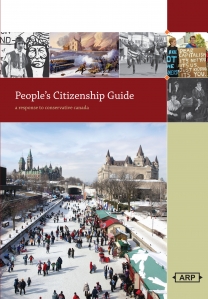
The People’s Citizenship Guide closely mirrors Discover Canada. It is broken down into the same ten sections as the book published by the government. Both texts address citizenship and identity, history, governance, symbols, economy, regions and issues Canadian citizens should consider
The biggest difference between these two works is that Canada’s colonial and liberal legacy is directly acknowledged in The People’s Citizenship Guide. Rather than taking Canada as a historical inevitability, with only ‘regrettable’ instances of social and ethnic conflict, The People’s Citizenship Guide more explicitly emphasizes that “Canada is a construct, a product of collective imagination and history” that in the past (and today) has included some people, while excluding others.
Treatment of Aboriginal peoples serves as a good example of the difference between the two guides. When the Discover Canada Guide was first released, historian Christopher Moore lamented the lack of discussion about Aboriginal people and treaties in the government’s portrayal of Canada’s past. The emphasis of the government’s text is on cooperation rather than conflict and dispossessions, making it seem that First Nations unconditionally welcomed European newcomers. The People’s Citizenship Guide is much more explicit about the inherent nature of First Nation’s sovereignty and the legacy (and complexity) of treaties and land dispossession.
At $14.95, it is unfortunate that The People’s Citizenship Guide will not be as accessible as the free Discover Canada Guide (available as a PDF online). In many ways, Jones’s and Perry’s text will better serve immigrants to Canada. Particularly in their discussion of the provinces and territories, The People’s Citizenship Guide is much more frank about each province’s and territory’s economic prospects, political challenges and complicated histories. For many immigrants it could be a helpful tool in assessing where in Canada they would like to settle. More generally, The People’s Citizenship Guide represents a more diverse and complex picture of Canada. The book pays greater attention to the rights of Canadian citizens and the resources available when those rights are infringed upon (though, both guides could discuss the Supreme Court of Canada in greater detail).
This book is a welcome political intervention. From its title through to its back cover, The People’s Citizenship Guide’s politics are open and easily discerned. Such overt and provocative language, which on the first page labels the vision of Canada presented in Discover Canada as “nationalistic, militaristic and racist,” may turn people off the book before they can digest its important content. That being said, the explicit nature of the book’s politics provides excellent contrast to the political perspectives that are often left implicit in Discover Canada. In publishing The People’s Citizenship Guide, Jones and Perry should be lauded for calling explicit attention to the politics of citizenship.
Indeed, one of the book’s strengths is that it closely follows the structure of Discover Canada. Both guides can literally be read side-by-side. There is significant pedagogical and civic merit to this exercise. Reading both books’ sections on trade and economic growth, for example, illustrates the political differences between these texts. Discover Canada begins its section on trade and economic growth with these two sentences:
“Postwar Canada enjoyed record prosperity and material progress. The world’s restrictive trading policies in the Depression era were opened up by such treaties as the General Agreement on Tariffs and Trade (GATT), now the World Trade Organization (WTO)” (DC 24).
The People’s Citizenship Guide takes a broader and more global perspective on the postwar period. Its section on trade and economic growth begins this way:
“The Canadian economy forms part of an unequal global economic system, a system which, shaped by the legacies of colonialism, continues to privilege industrialized nations over those of the global south. The postwar period was a time of economic boom for wealthy nations like Canada, and many Canadians achieved greater material comfort than they had previously enjoyed” (PCG 31).
This type of comparison makes the Discover Canada Guide and The People’s Citizenship Guide useful for teaching critical reading skills in high schools and introductory university courses.
The People’s Citizenship Guide does not intend to be a replacement for Discover Canada. To find out about government structures, how to vote, or the date of important national observances – like Sir Wilfrid Laurier Day (Nov. 20 for those of you who regularly fail the Historica-Dominion Institute’s quizzes) – one is better to consult the government’s official guide. If, however, you would like a short introduction to Canada that represents the diversity of Canadian experiences and contextualizes many of the critical issues currently facing Canadians, The People’s Citizenship Guide provides a useful starting point.
The People’s Citizenship Guide is being launched tonight in Winnipeg at 7 p.m. in the atrium of McNally Robinson at Grant Park. You can purchase a copy of the guide from Arbeiter Ring Publishing.
Source: http://activehistory.ca/2012/02/the-peoples-citizenship-guide/
Wednesday, February 8, 2012
Let’s Talk History! on Your Campus

PhD Student, University of New Brunswick
Did you know that February 20 is National Heritage Day in Canada? First established in 1974 by the Heritage Canada Foundation, each year the third Monday in February is widely recognised across our nation as a day to encourage Canadians to identify, protect and enhance their natural, cultural, and built environments.
This year, in recognition of National Heritage Day in February, the THEN/HiER Graduate Student Committee has initiated a program to advance more interdisciplinary dialogue about doing history. How this works is that history graduate students are invited to participate in an informal discussion with social studies/Canadian studies education students, on their university campuses, about historical inquiry.
For historians, doing history involves, among other things, research, writing, scholarly, and public dissemination of historical knowledge. It also involves adopting critical historical literacy methods that open up the interpretive nature of history. These historical literacy methods are key to teaching younger students how to think historically.
"Let’s Talk History" offers an easy and practical way of experiencing pedagogical-content knowledge in action.
As a member of the THEN/HiER Graduate Student Committee, I invite you to initiate a "Let’s Talk History!" dialogue on your campus. Let’s start talking with the next generation of social studies teachers and historians in Canada... along the way, we just might make some new friends, share, network, and deliberate.
Are you intrigued? Interested? Excited?! If so, please contact me via this blog post – or any of my fellow committee members. Funding is available to assist with related costs, and we can provide you with everything you need to make your event memorable. We invite you to be a part of this unique February initiative. Start up a dialogue on your campus!
Sunday, January 29, 2012
Interesting Blog About Playful Historical Thinking...
The Good, The Bad and the Ugly: Followup on Playful Historical Thinking Class Experiment - by Andrew D. Devenney
Last fall, I conducted an experiment in classroom pedagogy, building a modern European history course around the concept of playful historical thinking. I wrote about this in a guest post for Play the Past last September, which you can and should read here before continuing. I thought I would take this opportunity to give a quick follow-up on how the experiment went and where I hope to go from here.
Last fall, I conducted an experiment in classroom pedagogy, building a modern European history course around the concept of playful historical thinking. I wrote about this in a guest post for Play the Past last September, which you can and should read here before continuing. I thought I would take this opportunity to give a quick follow-up on how the experiment went and where I hope to go from here.
For those who don’t want to slog through the previous post, I’ll provide a quick refresher. There were three distinct elements to my playful historical thinking class redesign: 1) a modular course structure designed to emulate loosely a child’s toy playset and to facilitate collaborative group play; 2) different types of assessments designed to encourage personal student engagement with the historical materials in the course modules; and 3) a small competitive grade dynamic to encourage playful competition between the students. The syllabus for the course can be found here. The course wiki, which contains all of the students’ work during the class, can be found here.
The long and the short of it is that the experience was very much a mixed bag, with some elements of the design working well and some not so much. I wouldn’t go so far as to label the effort a complete failure, but I was not particularly happy with how it turned out. And since I’m a big proponent of scholars in the humanities and social sciences publicly and honestly discussing their failures along with their successes, let’s dig into this more, shall we?
Read more... http://www.playthepast.org/?p=2308
Monday, January 9, 2012
The class / Entre les murs (2008)
French School as Democracy and Stage
Dennis Lim, The New York Times (September 26, 2008):
"The Class," a French high-school drama that emerged as the popular underdog winner of the Palme d'Or at the Cannes Film Festival this year, belongs to the largely inspirational tradition of the classroom movie. Sometimes the films in this category are odes to youthful rebellion — Jean Vigo's "Zero for Conduct," Lindsay Anderson's "If ..." — but more often (and certainly in the American iterations) they are celebrations of the charismatic, inventive pedagogue, as embodied by Glenn Ford in "Blackboard Jungle," Michelle Pfeiffer in "Dangerous Minds" or Ryan Gosling in "Half Nelson."
"The Class" simultaneously revives and undermines this longstanding genre. Its director, Laurent Cantet, said he was mindful of it, not least because of one grating negative example.
"I didn't want to make a version of 'Dead Poets Society,' " Cantet said in a recent telephone interview, "a film where the teacher is brilliant and heroic and knows everything. I wanted to show a school in all its complexity, where the students don't always learn, and the teachers are not always sure of what they're doing."
The solution, although risky, was simple enough: use real students and real teachers.
Cantet, 47, is one of France's foremost practitioners of a realist, socially engaged cinema, leftist but not dogmatic, with an interest in the culture of the modern workplace and a tendency to inflect his fictional scenarios with strong elements of documentary. His first full-length feature, "Human Resources" (1999), a drama about a father-son conflict complicated by a parallel labor-management struggle, was shot in a factory in Normandy. Most of the actors were nonprofessionals, actual workers, bosses and union organizers playing versions of themselves.
"The Class," which will open the New York Film Festival on Friday (and will be released by Sony Pictures Classics on Dec. 12), is loosely based on a book by François Bégaudeau, itself a hybrid of fact and fiction, billed as an "autobiographical novel" and based on the author's experiences as a teacher. Bégaudeau is the star of "The Class," playing a character named François. The students and the other teachers are drawn from a junior high school in the 20th Arrondissement of Paris, a racially mixed neighborhood.
For some years Cantet had been toying with the idea of a film set in a high school. Both his parents were teachers, and as the father of two school-age children, he said, "I was curious about what their lives are like right now."
The concept fell into place when he read Bégaudeau's book, a best seller in France. "It give me a vision of the school from the inside," he said. He was also intrigued by Bégaudeau's description of his unorthodox and even combative teaching methods, the way he turned classroom back-and-forths into what Cantet called "an experiment in what democracy could be."
Something of a maverick, François is by no means infallible. "This teacher establishes a certain proximity with his students," Bégaudeau wrote in an e-mail message, referring to his alter-ego. "He gives them many occasions to express themselves, favors interacting over lecturing, collective thinking over a linear transmission of knowledge."
"He is the teacher that I was, that I wanted to be," he added. "A democratic teacher, with the baggage of approximation and chaos that comes with it. But in a classroom, as in society, democracy comes with a price. To be a democrat means to accept this price."
Cantet worked on the script with Robin Campillo, his regular co-writer, and Bégaudeau. "It was clear we were not doing a real adaptation of the book," Cantet said. "We would take situations and see if they could mean something to the children we found." Once a week for several months before the shoot, Cantet and Bégaudeau held open workshops that allowed the filmmakers to shape the characters to fit the actors.
The most eager students — about half of the 50 who responded to the casting call — ended up in the film. All are untrained actors, but self-consciousness was not a problem. "Many of them are already friends, and they were not embarrassed in front of one another," Cantet said. "They were also not affected by the lights and cameras. I think because of their generation the camera just felt normal for them."
"The Class" was shot on high-definition video, and to create a fly-on-the-wall effect in the classroom scenes Cantet had three cameras rolling at all times — one trained on Bégaudeau, another on the students, and a third continually on the prowl, "looking for the details that make the classroom real," Cantet said.
Bégaudeau functioned as a surrogate for Cantet, "directing the film from the inside," as Cantet put it, eliciting reactions from the students. "It was very convenient for the film," Bégaudeau said, "and it also enabled me to not focus on my acting and get tense."
The unforced verve of the performances across the board is striking, though maybe not surprising. As Cantet noted, the setting encourages theatricality. "School makes everyone an actor," he said. "The teacher is putting on a performance. The way he uses his body and his voice is an improvisation. Maybe that's why François is such a good actor." And for students the socializing aspect of school involves role playing and recognizable archetypes. "You have the tough guy, the good pupil, the bad one," he said. "Even in real life they are working with characters that have been assigned to them."
"The Class" evolves from observational scenes to a more pointed dramatic conflict, centered on the disciplinary action taken against a boy originally from Mali, but there are no obvious heroes or villains, a stance that Cantet and Bégaudeau both associated with the famous line from Jean Renoir's "Rules of the Game," "Everyone has his reasons."
Bégaudeau said: "Before judging your characters you try to understand their motivations, to understand a process rather than give grades on a moral scale. I believe that in 'The Class' everyone acts according to what they believe to be good, and what's tragic is that it still produces drama."
Bégaudeau, an occasional film critic who has written for Cahiers du Cinéma, placed Cantet within the humanist "Renoirian tradition," whose other heirs include, he said, Eric Rohmer, Maurice Pialat (the last French Palme d'Or winner, for 1987's "Under the Sun of Satan") and Abdellatif Kechiche, a contemporary of Cantet's whose films ("Games of Love and Chance" and the coming "Secret of the Grain") have an affinity with "The Class" in their attention to the lived reality of teenagers and of multicultural France.
As suggested by its French title, "Entre les Murs" ("Between the Walls"), "The Class" never ventures outside the school, but the classroom, as in all classroom movies, registers as a microcosm of society. While the riots of 2005 exposed the fissures of the new France, Cantet said he was striving for an optimistic portrait. "It was important to show the diversity in the classroom as something natural for the children and enriching for everyone," he said. But the utopia is tinged with ambiguity. "School is an integrating system, but it's also based on exclusion."
"The Class" opens in France this week and has already reignited arguments there about diversity and elitism in the education system, already a subject of public discussion in light of proposed reforms by the Nicolas Sarkozy government. Cantet said some conservative commentators have bristled at Bégaudeau's pedagogical approach: "He's not their idea of what a teacher should be."
Bégaudeau maintains he never intended to make a political point. "I did adjust the book according to certain aspects of the discourse of the school system, he said. "But above all I wanted to disarm all discourse by presenting facts too complex for any discourse to address fully. It's a way to bet on storytelling rather than ideas."
Cantet, for his part, had no interest in settling a conflict that defies resolution. "There is a very old fight in France, and I think everywhere, between the moderns and the ancients about the culture that we believe should enrich our children." he said. "The debate is much older than the film. The film provides arguments to both sides to continue this debate."
Subscribe to:
Posts (Atom)