Monday, December 10, 2012

Conversations on New Possibilities for the Future : A Virtual Interview with Viviane Gosselin, PhD.

Interview by Cynthia Wallace-Casey,
PhD Candidate
University of New Brunswick (Fredericton)

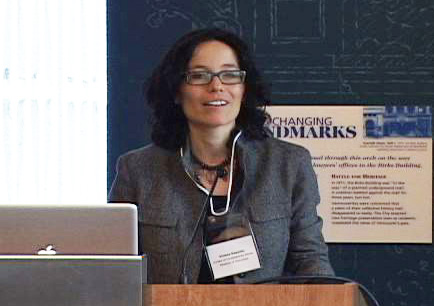
Last spring, I had the opportunity to engage in a “virtual chat” with the curator of contemporary issues at the Museum of Vancouver, Viviane Gosselin.  Viviane is also author of chapter 12 in New Possibilities for the Past: Shaping History Education in Canada (2011).
During the interview, Viviane chats about her current curatorial project, “Sex Talk in the City”, as well as the role of historical narratives in presenting alternative perspectives upon the present.  She provides great insight into the eclectic nature of museum work – rebounding between curatorial meetings, telephone conversations, conference presentations, and family commitments. Near the end of the interview, Viviane shifts her attention towards historical thinking in museums and writes of the necessity for “porous narratives” within museum exhibitions.

I began our e-mail conversation by discussing the THEN/HiER “unconference” that had just taken place at the Museum of Vancouver in conjunction with the America Education Research Association Conference:

 We'll start by chatting about your busy schedule. How did the "unconference" go during the AERA Conference?
Good lord, 3 telephone conversations later – here I am . . .


Friday, December 7, 2012

5 Things Really Smart People Do

By Kevin Daum (The Huffington Post):

Most people don't really think much about how they learn. Generally you assume learning comes naturally. You listen to someone speak either in conversation or in a lecture and you simply absorb what they are saying, right? Not really. In fact, I find as I get older that real learning takes more work. The more I fill my brain with facts, figures, and experience, the less room I have for new ideas and new thoughts. Plus, now I have all sorts of opinions that may refute the ideas being pushed at me. Like many people I consider myself a lifelong learner, but more and more I have to work hard to stay open minded.In Intellectual Character I made the case that it is not about "being" smart, it is about "acting" smart. Here are some tips to help us act smarter.

Source:
http://www.huffingtonpost.com/2012/12/05/5-things-really-smart-peo_n_2243995.html

Saturday, October 20, 2012

Education Week Blog - Museums Extending Youth Outreach

By Nora Fleming on October 5, 2012 4:46 PM

Science centers and museums are ramping up efforts to get children (and their parents) through their doors and using their resources to learn.

The Smithsonian Institution here in Washington, which supports 19 museums, nine research centers and more than 140 affiliate museums around the world (the largest museum and research complex in the world), recently announced a $1.4 million branding campaign called "Seriously Amazing," supported with funding from Target.

The campaign, themed with a question mark icon, is supposed to provoke interest and inquiry in subjects the museums could provide answers to by asking clever questions. Some of the questions are featured on the campaign's website here.
Read more...


Sunday, September 23, 2012

4 Step Reading Process for Middle Level Students and Primary Documents - Ohio Resource Center

A recent post to teachinghistory offers a four step process for teachers to use with middle school students in their analysis of primary documents. It offers an approach that highlights the more complex historical thinking skills found at the middle school level.

In the illustration provided, students analyze the texts of four speeches given by President Jackson around the time of the Indian Removal Act. Each text, along with its accompanying key questions, is included.

Read more...

There are also free posters for downloading - available here...

Everything Hinges on Assessment - By Justin Reich

Here's an interesting blog entry, by Justin Reich, about Sam Wineberg's Beyond the Bubble project at Standford. As in Canada, assessment within historical thinking remains a substantial topic for discussion. How to move beyond marking students merely for their ability to recall surface narratives or facts about the past. 

Read more here...  

Wednesday, July 11, 2012

Rating System for Evaluating Public History Web Sites

By Debra DeRuyver, Jennifer Evans, James Melzer, and Emma Wilmer
(Written and Mounted April 30, 2000)

Regular visitors to public history Web sites include historians and non-historians; academic and non-academic publics. Oft times, Web sites are used as the sole source of historical information on particular topics, particularly by K-12 and undergraduate students. Therefore, critical analysis of these sites is of the utmost importance. We as public historians have a responsibility to critique and evaluate these online resources, both to help improve the specific sites under review and to raise the bar for the entire field of public history. Site analyses provide benefits to several different groups:
  • The user gains an idea of the strengths and weaknesses of a site and the validity and reliability of the information contained therein.
  • The reviewed site benefits from a constructive outside appraisal.
  • Un-reviewed public history sites benefit from having models of best practices and common pitfalls.
  • Critical site analyses encourage better scholarship and more engaging presentations of public history.
  • Ultimately, the historical record is served by site analyses; site reviews provide traces of presentations of public history on the Web during its first decade of existence.
Table of Contents:


Friday, May 18, 2012

Aristotle's Teleology

Lecture 3 Aristotle's Teleology